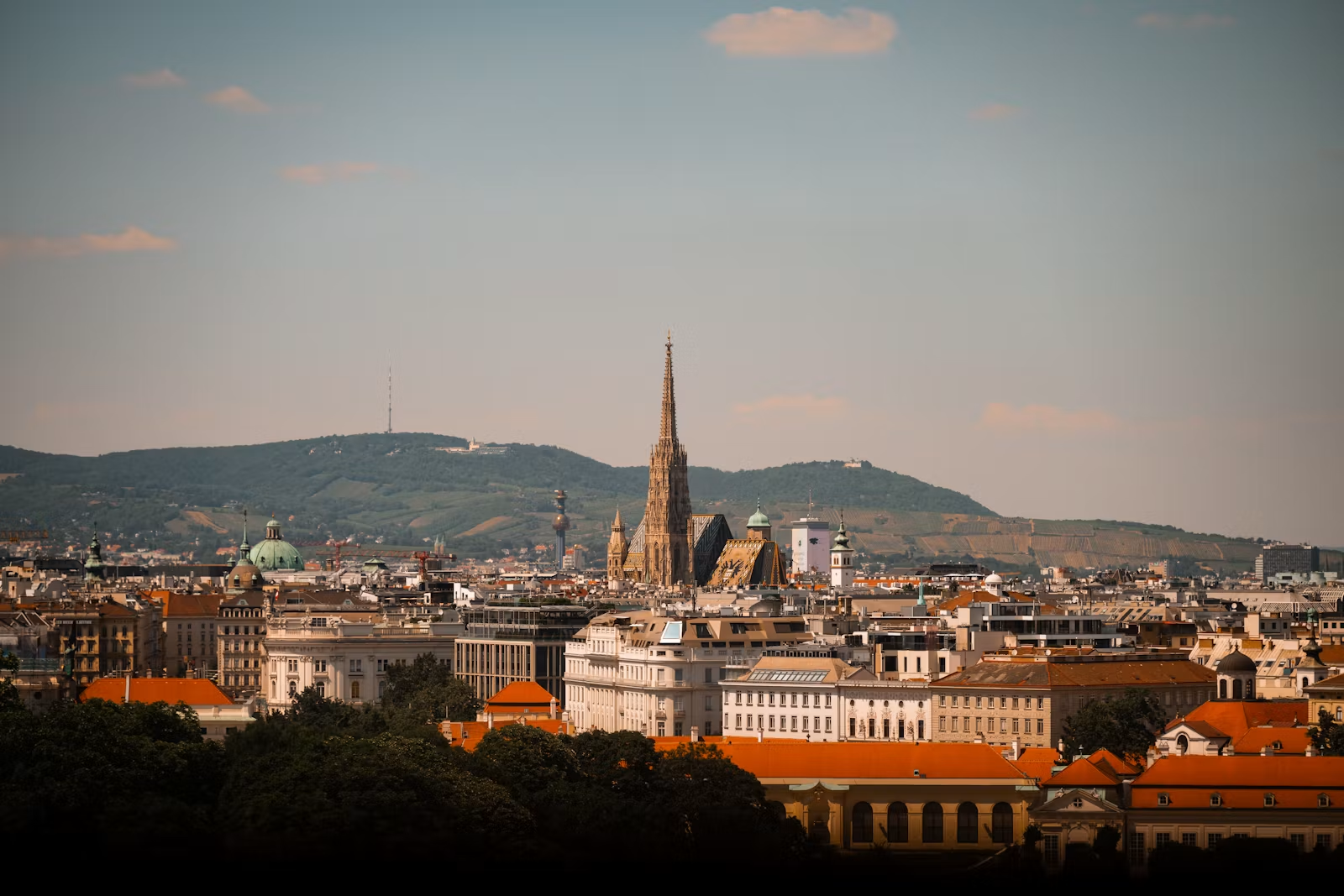
Wet lime leaves, grey stone, faces that give nothing away
Vienna in the rain smells of wet lime leaves and cold stone, and the stone is what you remember. Nobody smiles at you on the U-Bahn and nobody shoves you either, which takes two days to stop reading as hostility. Then the sun comes out, every courtyard grows tables, and the same closed faces turn friendly.
The Naschmarkt's front row, and the €60 horse
Two things I'd skip.
The restaurant strip at the Naschmarkt, the Karlsplatz end. The market is real: around 130 stalls, Monday to Saturday from 06:00, flea market Saturdays from 06:30. But the first stretch off the U-Bahn is a wall of near-identical terraces, laminated menus in four languages, a man outside each one asking where you're from. You get a seafood platter and a view of the next terrace.
The Fiaker. The Vienna Tourist Board publishes the rate and the operators list the same: €60 for about 20 minutes, €105 for about 40. The short loop is Petersplatz, the Burgtheater, the chancellery — streets you can walk in twenty minutes, for nothing, stopping where you like. The long one adds the Ring, which tram 1 does for the price of a ticket. I wouldn't pay €60 for that.
Brunnenmarkt, 948 metres of it, Saturday before one
Brunnenmarkt runs from Brunnengasse up to Yppenplatz in Ottakring: about 170 stands over 948 metres, by the city's own count, which makes it Vienna's longest street market.
Stalls trade Monday to Friday 06:00–21:00, Saturday 06:00–18:00, and the part that matters is the farmers' section: Friday and Saturday only, 06:00 to 13:00. Go Saturday around nine. Pumpkin-seed oil, sheep's cheese, apricots in season, flatbread off the tray. Then take a table at the Yppenplatz end and drink a coffee while the market packs up. My favourite hour in this city, and not a coach in sight.
The inspector wants €131.60 and he isn't in uniform
Wiener Linien has no barriers: you walk onto the U-Bahn with a validated ticket or you don't. Inspectors work in plain clothes, in pairs, and they like the first stop after a big interchange.
The surcharge in the official conditions of carriage is €131.60 on the spot, €141.60 within two weeks, €181.60 later, plus the fare. Buy at the machine before you go down: a single is €3.00 digital, €3.20 paper; 24 hours €9.70; seven days €25.20. The 48- and 72-hour tickets were scrapped in January.
The bell that fell through the roof in 1945
Stephansdom. On 12 April 1945 the cathedral burned and the old Pummerin, cast in 1711 from Turkish cannon taken in 1683, fell and shattered. It was recast in 1951 from its own fragments and hoisted into the north tower in 1957.
Riesenrad. Built 1897, 64.75 metres, thirty cabins. A bomb burned every one in 1944, and by 1947 the city could only afford to replace every second one. Hence fifteen.
Ringstraße. The first stretch opened on 1 May 1865: 5.2 kilometres round the old town, 57 metres wide. Trams 1 and 2 cover the circle on a normal fare, my answer to every sightseeing bus here.
Karlskirche. Karl VI vowed it during the plague of October 1713. Fischer von Erlach began in 1716; consecrated 1737.
Zentralfriedhof. Opened 1 November 1874, about 330,000 graves. Beethoven and Schubert were dug up elsewhere and reburied in group 32A. Viennese slang for dying is still "taking the 71", after the tram out.
Schönbrunn. The palace is the queue; the park behind it is free and enormous. Walk up to the Gloriette early.
Schnitzel at noon, Käsekrainer at three in the morning
Wiener Schnitzel is veal, hammered thin, fried until the crumb blisters off the meat; if it's pork the menu has to say Schnitzel vom Schwein. Tafelspitz, boiled beef with apple-horseradish, is what Vienna actually eats. Käsekrainer is a sausage with molten cheese inside. Kaiserschmarrn, a shredded pancake with plum compote, feeds two adults who won't admit it.
Gasthaus Pöschl is my pick for the sit-down version: a proper Beisl five minutes from the cathedral, daily 12:00–23:00, kitchen to 22:00. It's small — ring +43 1 513 5288. At the other end of the night, Bitzinger behind the opera sells sausages 08:00 to 04:00. In summer, Schweizerhaus does pork knuckle and beer, 15 March to 31 October.
Coffee houses went onto Austria's UNESCO intangible heritage inventory in 2011 and the etiquette follows. One coffee rents the table as long as you like. Order a Melange, not "a coffee"; the water is free and comes unasked.
4 February the Ring shuts for a ball
Kaiser Wiesn, Austria's biggest Oktoberfest, runs 24 September to 11 October 2026 on the Kaiserwiese in the Prater. The Christkindlmarkt runs 13 November to 26 December 2026, daily 10:00–22:00; the streets around it are solid from four.
The Opernball is 4 February 2027 at 20:15. The Ring by the Staatsoper closes and half the city watches the entrance on television in order to complain about it. My advice that night: stay off the first district.
The Vienna City Marathon is 18 April 2027, Reichsbrücke to the Ring, shutting the centre until mid-afternoon. The Donauinselfest is 25–27 June 2027, free. Leave the car where it is.
What's on
| When | What |
|---|---|
| 24 Sep – 11 Oct 2026 | Kaiser Wiesn, Austria's biggest Oktoberfest, on the Kaiserwiese in the Prater |
| 13 Nov – 26 Dec 2026 | Wiener Christkindlmarkt on Rathausplatz, daily 10:00–22:00 (24 Dec to 18:30) |
| 4 Feb 2027, 20:15 | The 69th Wiener Opernball at the Staatsoper; the Ring closes around the opera house |
| 18 Apr 2027 | Vienna City Marathon, Reichsbrücke to the Ring at the Burgtheater, from 09:00 until 15:30 |
| 25–27 Jun 2027 | Donauinselfest, free open-air festival on the Danube Island |