The trumpet goes off every hour, including at three in the morning
A bugler plays from the tower of St Mary's on the hour, day and night, from four windows in turn, and stops mid-phrase. Since 1927 the noon call has gone out live on Polish radio.
The Rynek has sides slightly over 200 metres, laid out in 1257, and everything worth walking to sits inside a park that used to be the wall. I cross the marked centre in twenty minutes and never want the car once I am inside it.
Two stories Kraków sells, and one ticket that will not scan
People queue at a corner of Wawel to press their hands on a wall said to be one of the earth's seven sacred energy stones. Mieczysław Tobiasz found nothing in the sources in 1967; Karol Estreicher blamed the man who ran Wawel's restoration in the 1920s. The castle roped the corner off in 2001, and I walk past it.
The costlier trap is a ticket. Since 4 October 2025 every online ticket to Schindler's Factory is personalised and photo ID is checked at the door, so the resale sites with official-sounding names are selling a document in someone else's name for more money. Buy from muzeumkrakowa.pl, wawel.krakow.pl, mariacki.com and visit.auschwitz.org.
The canteen the tax office subsidises
Bar Mleczny Pod Temidą is a milk bar on Grodzka, on the Royal Route, a hundred metres off the tourist flow and priced as if it were not. Milk bars are not nostalgia: they are still subsidised in 2026, by the tax administration, under a Finance Ministry regulation of 2015.
The mechanism explains the food. The subsidy is 70% of the raw-material cost — ninety-five listed dairy and vegetable ingredients — and the markup may not exceed 45%. In exchange the place must be self-service, alcohol-free and open to all. Hence the hatch, the absent beer and the price of the pierogi.
Two-tenths, and the headlights stay on in July
Poland's drink-drive limit is 0.2 per mille — low enough that one drink can reach it, and enforced by roadside testing visitors consistently underestimate. Treat it as zero.
Dipped headlights are compulsory 24 hours a day, all year, noon in July included. The compulsory kit is short and not the one you packed for the rest of Europe: a warning triangle and a fire extinguisher, no hi-vis vest and no first-aid kit. Motorways run at 140 km/h, the EU's highest, and studded tyres are banned.
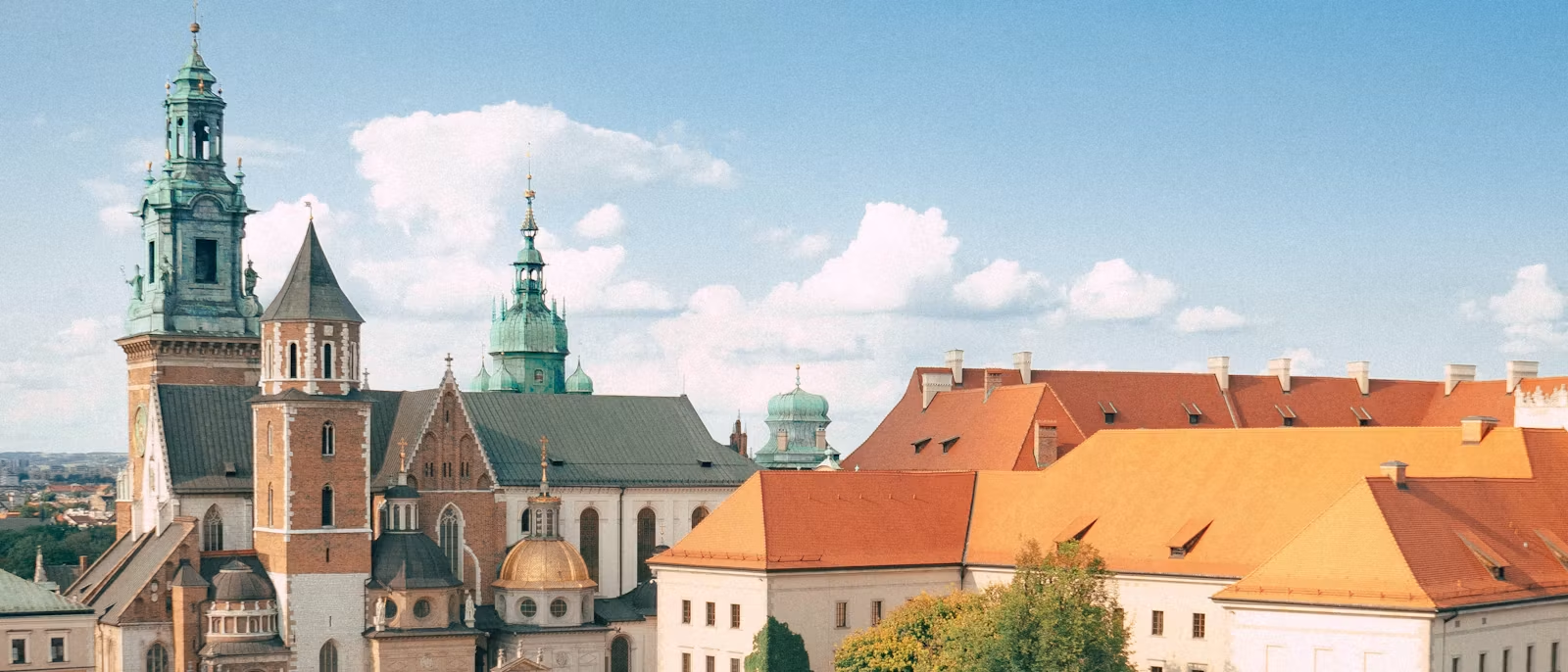
Wawel is not one ticket. It is eleven
Wawel Royal Castle sells a separate ticket per route and the sums climb fast: both castle floors 95 zł, one floor 57 zł, the Crown Treasury 47 zł, the Armoury 47 zł. Monday brings free entry to selected exhibitions, 10:00–16:00, windows only, limited numbers. The Dragon's Den is strictly seasonal, 24 April to 31 October — bad news in February.
The castle does not sell tickets to Wawel Cathedral and says so. Different body, 26 zł, and my pick of the hill: it is the one ticket up there that covers more than one thing — cathedral, Sigismund's Bell, the royal tombs and two museums.
St Mary's Basilica has two doors: tourists pay 20 zł at the south entrance, the main door on the square is for prayer and free. The tower is a separate 20 zł, May to October only, same-day tickets from Plac Mariacki 7.
Rynek Underground is 45 zł, free on Tuesdays; Schindler's Factory is 60 zł, free on Mondays — its shortest day, 10:00 to 15:00, box office only. Plac Bohaterów Getta in Podgórze costs nothing: thirty-three large chairs and thirty-seven small, on the square the deportations left from.
The bread ring with a legal diameter
The obwarzanek sold from every blue cart is a protected geographical indication, registered in 2010, and the specification is unusually exact: 12 to 17 cm across, 80 to 120 g, hand-twisted, boiled at 90 °C or more before baking, and made only in Kraków and the Kraków and Wieliczka poviats.
At Plac Nowy in Kazimierz, note what changed: the zapiekanka windows are in the outer ring of the round brick hall, and the inside reopened in 2025 as a food hall, Jatka 2.0, with no zapiekanki at all. Half the guides describing "the rotunda" mean the wrong half. Bottiglieria 1881 is the other extreme: Poland's only two-star Michelin restaurant.
The Thursday nobody drives, and the six weeks the square is gone
Corpus Christi is a public holiday, the Thursday sixty days after Easter — 27 May in 2027 by that rule, though Poland has not published the date. The disruption is not one procession but dozens of parish ones closing their own streets in turn, worst 09:30 to 14:00, and ZDMK advises against driving into the centre. Lajkonik follows on the octave, the Thursday after, crossing the old town in the afternoon.
The Christmas market then holds the Rynek from 27 November 2026 to 6 January 2027. And on 1 November the city runs seven extra tram lines and twenty-seven extra buses to the cemeteries; driving to Rakowicki that day is not a plan.
What's on
| When | What |
|---|---|
| 3 December 2026, expected | The szopki competition on the Rynek, 10:00–12:00 at the Mickiewicz monument — always the first Thursday of December, and a UNESCO-listed tradition since 2018 |
| 27 November 2026 – 6 January 2027 | The Christmas market fills the Rynek Główny, 10:00–20:00 daily, free to enter — six weeks with the square out of action |
| 27 May 2027 (calculated from the rule) | Corpus Christi, a public holiday — dozens of parish processions close streets in sequence across the city, worst between 09:30 and 14:00, and ZDMK advises against driving into the centre at all |
| 3 June 2027 (the octave of Corpus Christi) | The Lajkonik procession from ul. Senatorska through Zwierzyniecka, Franciszkańska and Grodzka to the Rynek — an afternoon straight through the old town |
| 1 November, every year | All Saints' Day at Rakowicki cemetery: seven extra tram lines and twenty-seven extra bus lines, all numbered from 8, and traffic changes published only in late October. Driving there is not viable |