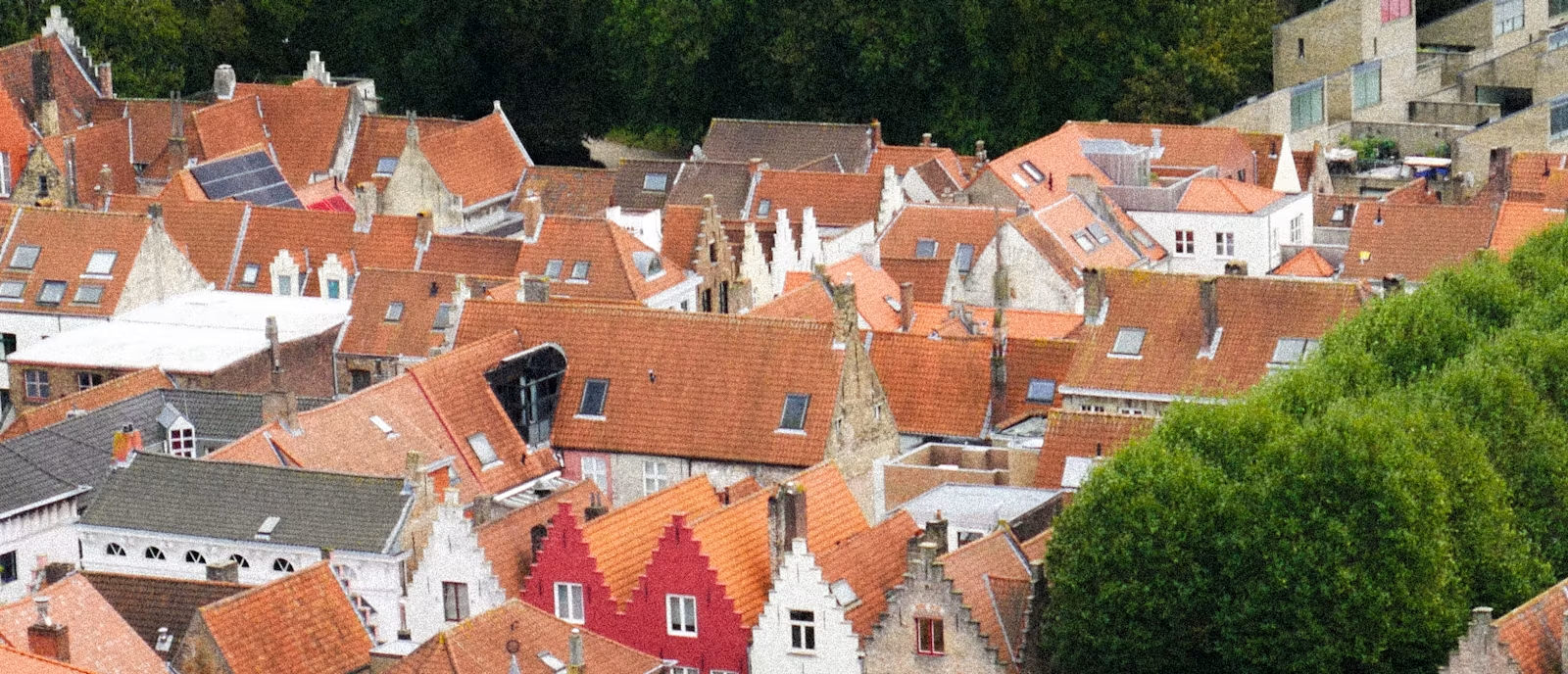
A town that was too poor to knock itself down
Bruges looks medieval because the Industrial Revolution went somewhere else. Nothing was demolished here in the 19th century because nothing was being built, and a town with no money keeps its old houses by default.
So you get brick, water and bells, at a scale you can cross in twenty minutes. I go at seven in the morning or after nine at night, when the day-trip coaches have not arrived or have already gone.
€22 for a story, when the Michelangelo is next door
The commercial museums cluster on the Markt and they are not cheap: Historium €22, Choco-Story €16, the Frietmuseum €12. Meanwhile the nave of the Church of Our Lady is free to walk into, and the Basilica of the Holy Blood on the Burg is free as well — only its treasury charges, €5.
One claim the chocolate museums lean on does not survive checking. The Brussels heritage inventory states flatly that no label specifically protects "Belgian chocolate" — no PDO, no PGI, no legal definition at all.
The café that has been open since 1515
Café Vlissinghe is in the Sint-Anna quarter, ten minutes north-east of the Burg and therefore invisible to most of the day-trip traffic. Its own sign gives the year: 1515.
It opens every day, 11:00 to 21:00, which in a town where much of the trade shuts one day a week is useful in itself. My advice is a weekday afternoon: two hundred metres off the route, a Bruges street goes completely quiet.
Three Belgian rules that catch everyone
Priority from the right is real, and it applies in car parks. Belgium still runs voorrang van rechts: you give way to whoever comes from your right, and the federal police are explicit that it reaches past junctions into car parks and open squares. Drivers arriving from Britain, the Netherlands or France's priority-road system get this wrong constantly.
The car needs four things, and one of them surprises everybody: a first-aid kit, a warning triangle, a hi-vis vest, and a fire extinguisher. And holding a phone is the offence, not using it — €174 on the spot.
366 steps, sold in twenty-minute slices
The Belfry is 366 steps, and entry is throttled to roughly 15–25 people per 20-minute slot, so booking is recommended rather than required. On the price the two official sources disagree — the operator lists €15 flat, the tourist board a €15/€16 seasonal split — so check on the day.
The Musea Brugge Card is €33 for 72 hours across twelve sites. The Belfry, the Groeninge and Sint-Janshospitaal are €15 each, so it pays for itself on the third museum and not before.
The Church of Our Lady splits in two: the church is free, and Michelangelo's Madonna and Child sits in the €8 museum section. Most people are told only one of those halves.
A canal boat is €15 for half an hour, and the price is set by the City of Bruges rather than the five operators, so there is nothing to shop around for. And the Jan Breydel statue on the Markt commemorates a man whose role, per the Flemish government's own canon, is largely fictional.
The chip shop is heritage; the chocolate is not
Belgium's frietkot culture — the chip-shop tradition, not the chips — is listed on all three of the country's community heritage inventories, recognised between 2014 and 2017. It is a Belgian listing, not a UNESCO one, whatever you read. The documented technique is double frying; beef fat is not a rule.
Beer is where the legal protection actually lives: "Oude Geuze" and "Oude Kriek" are registered EU Traditional Specialities Guaranteed, while plain "geuze" or "kriek" on a label guarantees nothing.
De Halve Maan brews in the centre and sends the beer out underneath it: a 3,276-metre pipeline, 34 metres down at its deepest, opened 16 September 2016 and drilled entirely under public ground. The tour is €16 with a beer, and warns you about its own 220 steps. t Brugs Beertje pours a few hundred Belgian beers and is closed on Wednesdays.
Twelve weeks of lights, and one afternoon the city shuts
Wintergloed runs 20 November 2026 to 14 February 2027, with an ice rink and a winter bar in Koning Albert I-park. The Christmas markets are shorter — 20 November to 3 January, on the Markt and Simon Stevinplein, 11:00 to 20:00 and an hour later on Friday and Saturday.
The date to plan around is the Procession of the Holy Blood, 6 May 2027. It leaves the Dijver at 14:30, and the published closures start long before: parking restrictions from 05:00, streets closed from 08:00. If your car is inside the centre that morning, move it the night before.
What's on
| When | What |
|---|---|
| 20 November 2026 – 14 February 2027 | Wintergloed, the city's winter light season, with the ice rink and winter bar at Koning Albert I-park |
| 20 November 2026 – 3 January 2027 | Christmas markets on the Markt and Simon Stevinplein, 11:00–20:00 Sunday to Thursday and until 21:00 on Friday and Saturday |
| 6 May 2027 | Procession of the Holy Blood, 14:30 from the Dijver — parking restrictions start at 05:00 and streets close from 08:00 |
| 24 April – 5 September 2027 | Bruges Triennial, about a dozen installations through the streets and waterways, free and open air |
| 9–11 July 2027 | Cactusfestival in the Minnewaterpark, on the southern edge of the centre |